
Claude Code — Extension Architecture
When I first started using Claude Code, it felt like a powerful but somewhat opaque tool. You type a prompt, it writes code, and magic happens. But as I dug deeper, I realized there's an entire architecture of extension points underneath — a composable system of 12 distinct mechanisms that, once understood, transforms how you work with AI-assisted development. I decided to map it all out visually because I couldn't find a single reference that showed the complete picture.
Why This Matters
The shift from "AI as chatbot" to "AI as development platform" is one of the most significant changes happening right now. Claude Code isn't just answering questions — it's running in a lifecycle with hooks, permissions, memory, tools, and agents that you can customize at every level. Understanding this architecture is like understanding the extension model of your IDE: once you see the seams, you start building on top of them rather than just using the surface.
What struck me most while mapping this out is how thoughtfully the layers compose. You can start with nothing more than a CLAUDE.md file — a simple markdown document with instructions — and progressively add sophistication. Skills give Claude domain expertise. Hooks automate lifecycle events deterministically, outside the AI entirely. MCP servers connect to external APIs via an open protocol. Custom agents let you define specialized personas with their own tools and permissions. And plugins bundle all of this into distributable packages.
The Session as the Central Concept
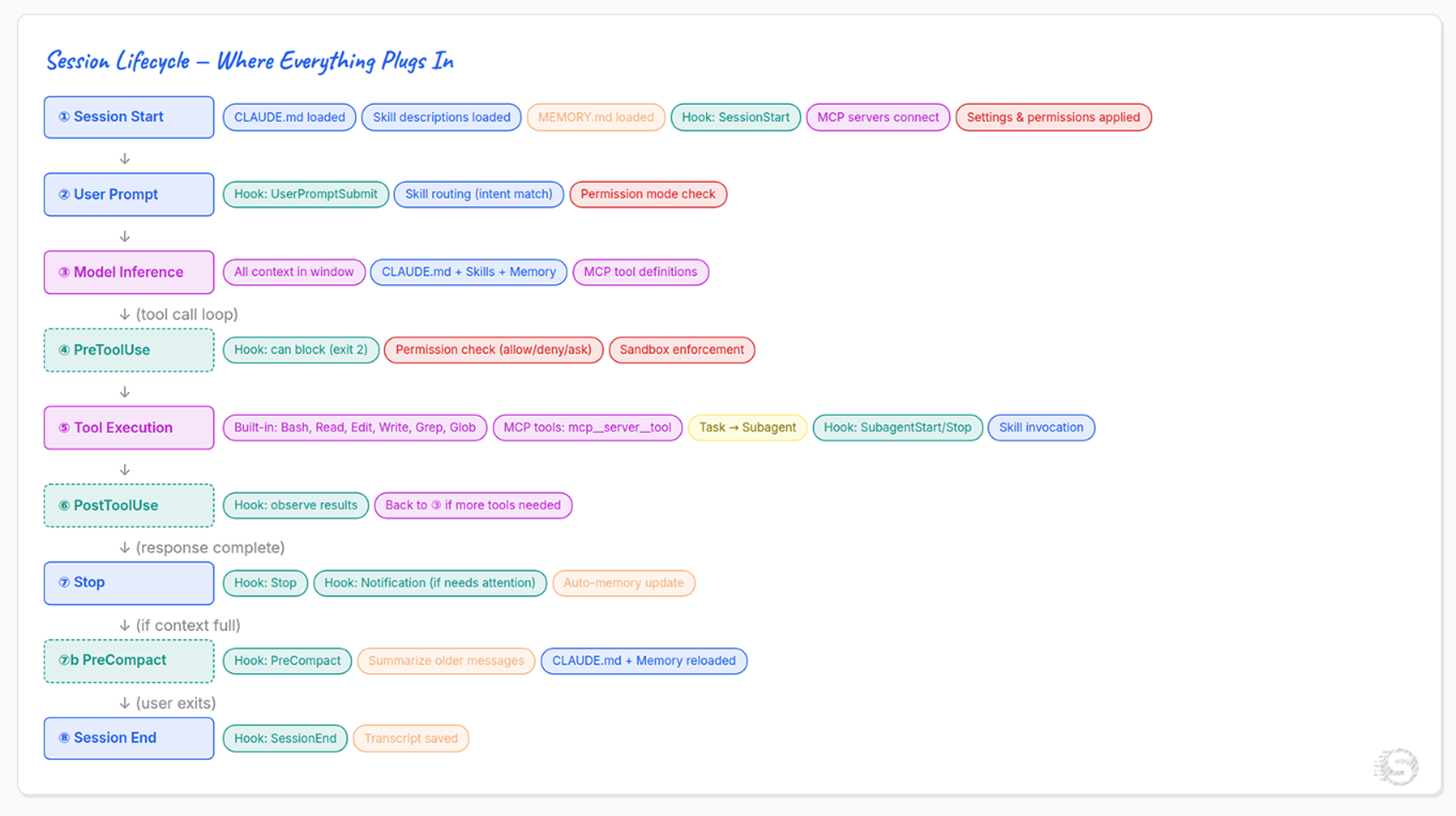
Everything revolves around the session lifecycle. From the moment a session starts — loading instructions, connecting MCP servers, reading memory — through each prompt-inference-tool cycle, to the final transcript save at session end, every extension mechanism has a well-defined place where it plugs in.
The architecture diagram traces this flow step by step, showing which mechanisms activate at each stage. The PreToolUse hook, for example, is the only point where external code can actually block an action (by returning exit code 2). That's a deliberate design choice: security gates belong at specific, auditable points in the lifecycle, not scattered throughout.
Memory That Compounds
One aspect I find particularly elegant is the memory system. Auto-memory gives Claude per-project persistent knowledge via MEMORY.md files — the first 200 lines load automatically at every session start, with topic-specific files loaded on demand. Combined with session transcripts saved as JSONL and automatic context compaction when conversations grow long, you get an AI that genuinely learns about your project over time.
This isn't just a convenience feature. It fundamentally changes the economics of working with AI. Instead of re-explaining your project's architecture, coding conventions, and quirks in every session, Claude accumulates understanding. The context window isn't just a technical limit anymore — it's a managed resource with explicit strategies for what persists, what summarizes, and what reloads.
Agents and the Future of Delegation
The agents layer is where things get truly interesting for enterprise development. Subagents spawn isolated contexts for parallel or specialized work. Custom agents defined in markdown files get their own tools, models, and permission modes — an analyst agent doesn't need write access, a reviewer agent can run in plan mode. And the experimental agent teams feature hints at a future where multiple Claude instances coordinate through shared task lists and peer-to-peer messaging, with no central manager required.
This is the kind of architecture that scales. Not just technically, but organizationally. Teams can define project-level agents, share MCP configurations, enforce coding standards through managed policies, and still allow individual developers their personal customizations.
A Composable Philosophy
The architecture follows a clear three-pillar philosophy: Define what Claude knows and can access, Automate what should happen deterministically at lifecycle boundaries, and Extend capabilities through external tools and delegation. Each pillar has multiple mechanisms, but they all share a common design language — markdown for instructions, JSON for configuration, lifecycle events for integration points.
What I appreciate most is the restraint. Every mechanism has a clear purpose and doesn't try to do everything. CLAUDE.md is for always-on instructions; skills are for triggered domain expertise; hooks are for deterministic automation. The boundaries are clean, which means the system stays comprehensible even as it grows more powerful.
The full architecture reference is available as the title image above. There's also an interactive version with expandable details for each mechanism if you want to explore the specifics.